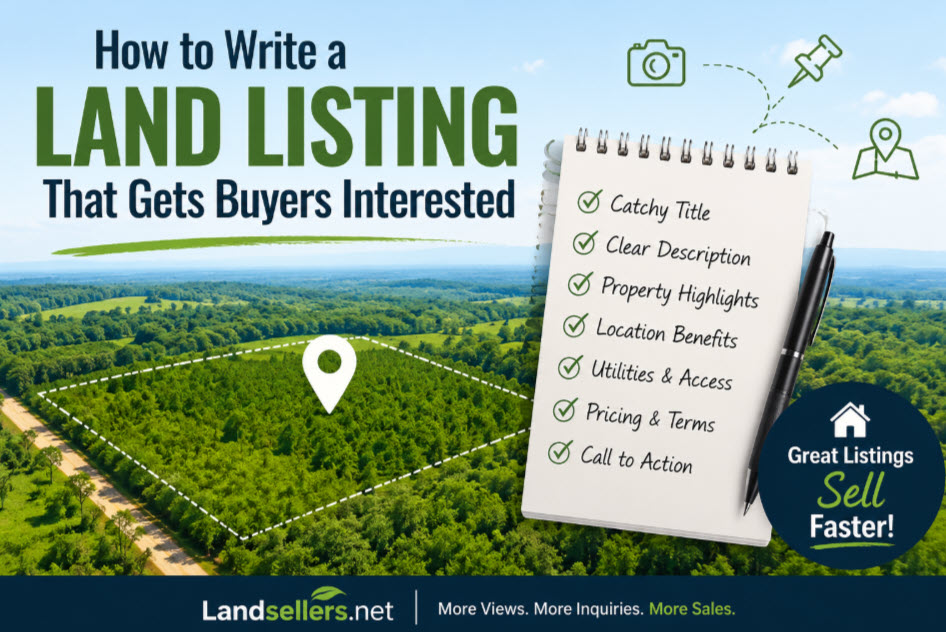
Selling vacant land is different from selling a house. A home listing can immediately show buyers bedrooms, kitchens, bathrooms, and living spaces. With vacant land, there may be no building at all. That means your land listing has to do more work.
A strong listing should help potential buyers quickly understand what the property is, where it is located, what makes it attractive, what they can potentially use it for, and what they need to know before making an offer.
Whether you are selling a small residential lot, rural acreage, recreational land, farmland, or an investment property, a well-written listing can make your property more appealing and help attract more serious inquiries.
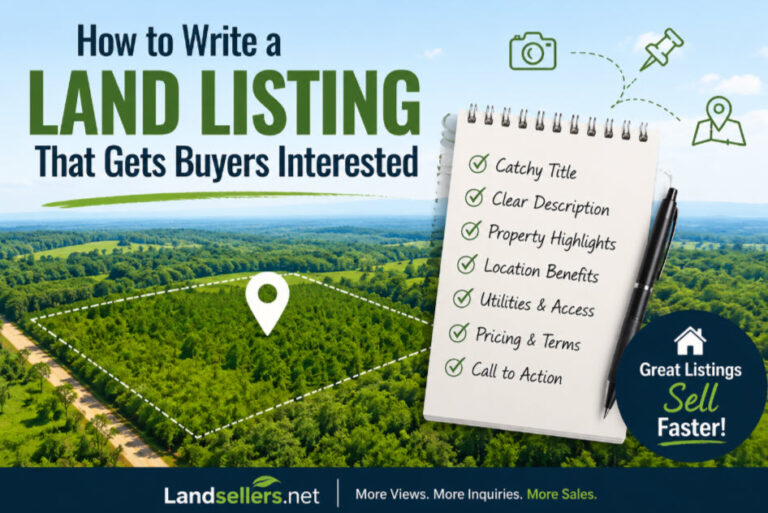
In this guide, we’ll explain how to write a land listing that gets buyers interested and what information you should include before publishing your property on LandSellers.net.
1. Start With a Clear, Specific Title
Your title is one of the first things a potential buyer sees. A vague title such as:
“Beautiful Land for Sale”
doesn’t tell buyers much.
Instead, make your title specific and useful.
For example:
1.5 Acres of Vacant Land for Sale in Jefferson County, Alabama
or:
5 Acres of Wooded Land Near XYZ, Arkansas – Great Recreational Property
A good title can include:
- Acreage
- County
- State
- Nearby town or city
- Property type
- A major feature
- Potential use, when appropriate
Recent guidance from Land.com recommends using specific buyer-oriented language rather than relying on generic descriptions. Location, acreage, intended use, and important features can help your listing better match the way buyers search for land online.
2. Put the Most Important Information First
Don’t make buyers read several paragraphs before finding basic property information.
Start your description with the information they are most likely to want:
- Property size
- Location
- Asking price
- Parcel number
- Property type
- Access
- Zoning, if verified
- Utilities
- Major land features
- Financing options, if available
For example:
Property Overview
This 2.5-acre parcel is located in [County], [State], near [Town]. The property offers a peaceful rural setting and may be suitable for recreational use, investment, or other uses permitted by local regulations. The property has [road access], and utilities are [available nearby / not currently connected / information should be verified].
This approach gives buyers a quick overview before they decide whether to continue reading.
3. Explain What Makes the Property Interesting
Don’t simply list facts. Explain why those facts may matter to a buyer.
Instead of writing:
“The property is 3 acres and wooded.”
you could write:
“This 3-acre wooded parcel offers privacy and a natural setting, making it an interesting option for buyers looking for recreational land, a private getaway, or a long-term land investment.”
The difference is that the second version helps buyers visualize the property.
However, be careful not to promise something you cannot verify. Don’t say a property is “perfect for building” unless you have confirmed the relevant requirements. Local zoning, access, utilities, septic requirements, environmental conditions, and other regulations can affect what a buyer can actually do with the property. LandSearch similarly recommends providing accurate information about zoning, utilities, access, parcel information, and other important property details.
4. Help Buyers Visualize the Land
Vacant land can be difficult to understand from a few sentences.
That’s why your description should help buyers imagine what the property looks and feels like.
Consider describing:
- Terrain
- Trees and vegetation
- Open areas
- Views
- Water features
- Road frontage
- Privacy
- Surrounding properties
- Nearby roads
- Nearby towns
- Recreation opportunities
- Whether the land is flat, sloped, wooded, or open
For example:
“The property features a mix of mature trees and open areas, creating a private setting away from the busier areas of town. A nearby county-maintained road provides access to the area, while the surrounding countryside offers a quiet environment for buyers looking for recreational or long-term investment land.”
Use descriptions that are factual and easy to understand.
5. Be Specific About Location
Location is extremely important when selling land.
A buyer may be interested in a property simply because it is close to a particular town, highway, lake, national forest, or other attraction.
Instead of only listing the county, provide useful location information such as:
- County
- State
- ZIP code
- Nearest town
- Major nearby highways
- Approximate distance to nearby cities
- Nearby recreational areas
- GPS coordinates
- Parcel number
If the property does not have a traditional street address, explain how buyers can locate it.
Accurate mapping can also make a listing more useful. Land.com notes that mapped properties can appear in map-based searches and that boundary information can help buyers understand where the property is located.
If you provide parcel boundaries, make sure they are accurate and clearly identified as approximate when appropriate.

6. Clearly Explain Road Access
One of the questions many land buyers have is:
“How do I get to the property?”
Don’t leave buyers guessing.
If the property has road access, explain what you know:
“The property is accessed from [Road Name], a publicly maintained road.”
If access is through a private road, explain that clearly.
If legal access has not been independently verified, don’t claim that it does. Legal access and physical access are not necessarily the same thing.
This is an important distinction because buyers may need to investigate recorded easements, road rights, and local requirements before purchasing.
LandSearch recommends sellers address legal access and other potential buyer concerns before marketing a property.
7. Don’t Ignore Utilities
Utilities can have a major impact on a buyer’s decision.
If you know the status of utilities, include it in your listing.
For example:
- Electricity available nearby
- Electric service at the property
- Well required
- Public water available
- Septic system required
- Sewer available
- No utilities currently connected
Avoid saying “utilities available” if you have not verified what that actually means.
A better description might be:
“Power lines are located in the surrounding area. Buyers should contact the local utility provider to confirm availability and connection costs.”
This is more transparent and protects buyers from misunderstanding the listing.
8. Include Zoning and Potential Uses Carefully
Potential buyers want to know what they can do with the property.
If you have verified zoning information, include it.
For example:
Zoning: Residential
or:
Zoning: Agricultural
You can also mention potential uses when appropriate:
- Residential
- Recreational
- Agricultural
- Hunting
- Farming
- Timber
- Camping
- Investment
- Vacation property
But avoid guaranteeing that a buyer can build a home, place an RV, install a mobile home, subdivide the property, or use it for another specific purpose unless those claims have been verified with the appropriate local authority.
Land.com emphasizes that a strong listing should answer practical buyer questions about access, utilities, intended use, and other factors affecting a property’s usability.
9. Use High-Quality Property Photos
Even the best-written description can struggle if the photos are poor.
Your first image is especially important because it may be the image that convinces someone to click on your listing.
Use photos that show:
- The land itself
- Road access
- Views
- Terrain
- Trees
- Open areas
- Water features
- Nearby surroundings
- Property entrance
- Important features
Avoid using only generic landscape photos.
LandSearch recommends high-quality photos that are actually taken on the property, with the cover photo showing the property itself.
Land.com also recommends putting your strongest property photograph first because it creates the initial impression of the listing.
10. Consider Adding a Property Map
A map can be especially valuable when selling vacant land.
A buyer may want to understand:
Where exactly is this parcel?
A good listing can include:
- Property location
- Parcel boundaries
- Nearby roads
- Nearby towns
- GPS coordinates
- Important landmarks
If you have a reliable parcel map or boundary map, make it easy for buyers to find.
This can reduce confusion and encourage buyers who are seriously considering visiting the property.
11. Be Honest About the Property
One of the best ways to attract serious buyers is to provide accurate information.
Don’t hide important limitations.
If the property is:
- Landlocked
- Heavily sloped
- Subject to restrictions
- Without utilities
- In a flood-prone area
- Accessed by an unpaved road
- Not currently buildable
- Subject to HOA or deed restrictions
explain what you know.
Honest information doesn’t necessarily make a property less attractive. In many cases, it helps you attract the right buyer.
A buyer looking specifically for recreational land may not care that the property isn’t suitable for a conventional home. A buyer looking for a homesite may care a lot.
The goal isn’t to make every buyer interested. The goal is to make the right buyers interested.
12. Make the Description Easy to Scan
Large blocks of text can make an online listing difficult to read.
Use short paragraphs and headings.
For example:
Property Highlights
- 2.5 acres
- Located in [County], [State]
- Wooded setting
- Road access
- [Verified zoning]
- [Utility information]
- [Nearby attraction]
- Cash or financing options available

Location
Describe the property’s location and nearby towns or attractions.
Potential Uses
Explain possible uses based on verified information and applicable local regulations.
Access & Utilities
Explain what you know about roads, utilities, water, septic, and other infrastructure.
Important Information
Include any restrictions, disclosures, or buyer due-diligence requirements.
This structure makes it much easier for buyers to find the information they need.
13. Include a Clear Call to Action
Once a buyer has read your listing, tell them what to do next.
For example:
“Interested in this property? Contact us for additional information, parcel details, or to discuss the next steps.”
Or:
“Want to learn more about this property? Reach out today to ask questions or schedule a visit.”
A simple call to action can turn a passive reader into a potential lead.
14. Use Natural SEO Keywords
Your land listing should also be written with search engines in mind.
However, don’t fill the description with repetitive keywords.
Instead, naturally mention important information such as:
- Land for sale in [State]
- [County] land for sale
- Vacant land
- Acreage for sale
- Recreational land
- Rural property
- Land investment
- Property near [Town]
For example:
“This 5-acre parcel of rural land for sale in [County], [State], offers buyers an opportunity to own acreage in a peaceful area near [Town].”
The important thing is to write for people first and search engines second.
Recent Land.com guidance specifically recommends using the language buyers naturally use when searching for properties rather than relying on keyword repetition.
15. Don’t Copy the Same Description for Every Property
If you are selling multiple parcels, it can be tempting to use the same description and simply change the acreage and location.
Try to avoid this.
Each property has something different to offer.
A wooded 5-acre parcel should not have exactly the same description as a flat 1-acre residential lot.
Unique descriptions can also help your listings stand out and provide more useful information to search engines and buyers. Land.com recommends creating unique content and notes that original listing content can help a property stand out.
Example of a Strong Land Listing
Here is an example of how all of these elements can come together:
2.5 Acres of Rural Land for Sale in [County], [State]
Looking for affordable acreage in a peaceful rural setting? This 2.5-acre parcel in [County], [State] offers an opportunity for buyers looking for recreational land, a private getaway, or a long-term investment.
The property is located near [Town] and offers convenient access to [Road/Highway]. The surrounding area features a mix of wooded properties and open countryside, providing a quiet setting away from busy urban areas.
Property Highlights:
- 2.5 acres
- Located in [County], [State]
- Rural setting
- [Wooded/open/mixed terrain]
- [Road access information]
- [Zoning information, if verified]
- [Utility information]
- [Distance to nearby town]
- Parcel number: [Parcel Number]
The property may be suitable for [verified potential uses]. Buyers should independently verify zoning, permitted uses, utilities, access, property boundaries, and any applicable restrictions with the appropriate local authorities before purchasing.
Interested in learning more? Contact us for additional property information and details about how to move forward.
Final Thoughts: Write for the Buyer, Not Just the Property
A successful land listing isn’t simply a collection of property facts.
It should answer the questions a potential buyer is already asking:
Where is the property?
What does the land look like?
How much land is there?
How can I access it?
What can I potentially use it for?
Are utilities available?
What are the zoning and restrictions?
What makes this property worth considering?
How can I learn more or make an offer?
The more clearly your listing answers these questions, the easier it becomes for buyers to determine whether the property is right for them.
When creating a listing on LandSellers.net, focus on accurate information, strong photos, a clear title, useful property details, and a description that helps buyers understand the opportunity. You don’t need exaggerated sales language. You need clarity, honesty, and information that helps the right buyer take the next step.
A well-prepared listing can make your property easier to discover, easier to understand, and ultimately easier to sell.
Follow us on Facebook at https://www.facebook.com/LandSellers.net/ to stay updated on the latest land deals and property listings from Landsellers.net!